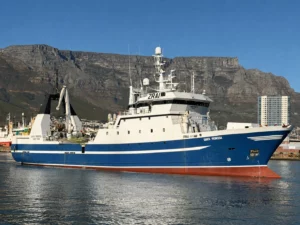
(Photo: Steve Yaxley)
The recurring breakdown of South Africa’s fisheries research vessel Africana threatens the 40-year data record that underpins the trawl fishery for hake and its long-standing certification by the Marine Stewardship Council (MSC). Johann Augustyn, Executive Secretary of SADSTIA, discusses the seriousness of the problem and looks for solutions.
Why South Africa can’t afford to lose its programme of scientific research surveys
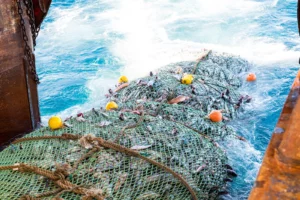
Since 1986, South Africa has conducted a summer and an autumn survey of its hake stocks. These are substantial undertakings: each survey typically consists of 100 to 120 trawls, most of them between the 100m and 500m depth contours, with some extending beyond 1000m. The depth range is important because the trawl fishery depends on two species – shallow-water and deep-water hake – whose depth distributions overlap but are not identical, and whose relative abundance shifts over time and by area. The summer survey covers the west coast, from the Orange River to Cape Agulhas, while the autumn survey assesses the south coast, from Cape Agulhas to Port Alfred.
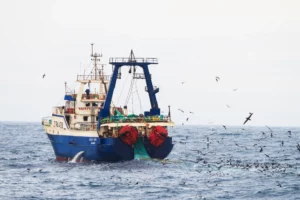
For most of the past 40 years, these bi-annual demersal research surveys have run like clockwork. That is no longer the case. The Africana is old, and over the past decade at least four or five demersal surveys have been postponed or missed entirely because of vessel breakdowns. Since the start of 2025 alone, three surveys have been missed as a direct result of the vessel’s condition. Government and industry are engaging constructively on the problem, but the downward trend raises two questions: just how important are these surveys, and what is the solution?
The answer to the first question is straightforward: the surveys are exceedingly important. Forty years of consistent, methodologically comparable trawling, conducted in the same areas at the same time of year, have built a solid, reliable time series. That time series forms one of two pillars supporting the hake operational management procedure (OMP) – the mechanism used to set an annual total allowable catch (TAC). The other pillar is the fishing industry’s own catch data, which generates a catch-per-unit-effort measurement. Importantly, the two datasets verify one another: survey data provides a fishery-independent measure of abundance, while commercial catch rates reflect what the fleet is actually experiencing in the fishing grounds. Together they provide a far more robust basis for stock assessment than either could do alone.
Setting a TAC involves rigorous testing through mathematical modelling, undertaken jointly by government, independent and industry scientists, and coordinated and approved by a scientific working group. This methodology has satisfied the MSC, which closely scrutinises the science behind the trawl fishery’s management and has certified it as sustainable and well-managed since 2004. The international success of the trawl fishery for hake depends heavily on that certification. A 2016 study (Lallemand et al., 2016) found that certification opened export markets in northern Europe that South African producers would not otherwise have penetrated, and calculated that losing it would put up to 1 421 jobs at risk – 32.5 percent of the hake-processing workforce – with the industry’s annual R8.6 billion contribution to GDP falling by between 28.3 and 54.3 percent.
Since 2004, MSC certification has been renewed every five years on the strength of continuous, credible science. If one pillar of the OMP is weakened, the case for “sustainable and well-managed” becomes harder to make – not just to MSC auditors, but as a matter of fact, because the fishery would genuinely know less about its own resources than it does today.
What happens if the surveys stop?
This is no longer a hypothetical question. Scientists from the University of Cape Town’s Marine Resource and Assessment Management group have already modelled it, projecting the 2022 OMP forward two decades under several scenarios: surveys continuing as usual, surveys stopping altogether, surveys held every second year, and surveys conducted by industry vessels instead of the Africana.
Their results show the OMP copes, in the narrow sense that it does not break down. But without surveys, the average catch it predicts over the next decade falls from around 151 000 tons a year to about 148 000 tons, and the range of likely outcomes narrows too, leaving less room for the fishery to benefit in good years. Using industry vessels instead of the Africana makes little difference because the model already corrects for their slightly lower efficiency at survey work. Surveys every second year produce a result somewhere between the two extremes.
The more troubling finding concerns something harder to see. Commercial catch rates can rise for reasons that have nothing to do with a healthier resource, including variables like better gear, sharper skippers and improved use of technology. If that happens gradually and without survey data to identify the trend, the modelling shows that deep-water hake could decline steadily while the numbers used to set the TAC continue to look reassuring. It is precisely this kind of blind spot – invisible from the deck of a fishing vessel, but visible through an independent scientific survey – that the Africana‘s data record exists to guard against.
The monetary value of surveys
This is not the first time the value of research surveys has been put to the test. In 1999, in an article for SA Shipping News and Fishing Industry Review, fishery scientists Manuel Barange and José de Oliveira, set out to answer a simple question about the Africana‘s acoustic survey programme for anchovy and sardine: would a simpler, cheaper monitoring system deliver the same result as the annual stock assessment surveys? Their answer was unequivocal and the numbers were stark: under the OMP in place at the time, an anchovy fishery supported by two surveys per year could sustain an average catch of 230 000 tons a year, falling to around 200 000 tons with only one survey per year, and falling further still to 168 000 tons (a loss of more than a quarter of the catch) if both surveys were cancelled. Barange and de Oliveira put the surveys’ value to the small pelagic industry at more than R130 million a year in fishing products, against an annual running cost for the Africana of about R1.8 million. They concluded that cutting survey effort would be “extremely short-sighted”.
Small pelagic stocks are much smaller today than they were in 1999, with anchovy and sardine TACs at 140 000 tons and 65 000 tons, respectively, in 2024. Reapplying Barange and de Oliveira’s rand figures to today’s much smaller fishery would overstate the case for research surveys, but if the same proportional relationship is accepted, the anchovy fishery alone stands to lose in the order of 30 000 to 40 000 tons a year without a survey programme behind it. Regular research surveys are particularly important for anchovy and sardine because both are short-lived species; a recruitment pulse not caught by the fishing industry in one season results in a lost catch rather than deferred income. Hake is different, because a fish left uncaught in one year is theoretically worth more the following year. This means the results of Barange and de Oliveira’s analysis cannot be neatly extrapolated to the trawl fishery, but the underlying economic principle is the same: a relatively small investment in research surveys buys a scientific record whose value to the industry, and to the country, is a large multiple of that cost.
What is the solution?
A range of solutions is being discussed between industry and government, each with its own trade-offs. The most direct is replacing the Africana with a new, purpose-built vessel, at an estimated cost of at least R1 billion. A second option, used before, is for government to charter industry-owned vessels for stock assessment – workable in principle, but costly for government and disruptive for vessel owners who risk falling short of their own quotas while their vessels do government’s work. A third, potentially more sustainable option is a public–private partnership established specifically to operate a research vessel on behalf of both government and industry. Such a model would need to be carefully structured to ensure that costs and responsibilities are shared appropriately, recognizing that fisheries research and stock assessment are ultimately public functions that serve national economic objectives.
The fishing industry and government have a strong history of working together on difficult problems, and the future of South Africa’s fisheries research capability should be treated as one of the most important. As industry engages with newly appointed Minister of Forestry, Fisheries and the Environment, David Maynier, maintaining the integrity of the hake time series is likely to be high on the agenda.
What this moment requires above all is clarity about the stakes. The demersal survey programme is not simply an investment in good science, it is a strategic national asset. Four decades of largely uninterrupted data underpin sustainable resource management, support MSC certification, safeguard access to premium export markets, and help protect thousands of jobs throughout the fishing value chain.
Whether the solution is a replacement vessel, charter arrangements or an innovative public–private partnership, action will almost certainly cost far less than allowing the survey programme to fail. The real question is not whether South Africa can afford to invest in fisheries research capacity, but whether it can afford not to.