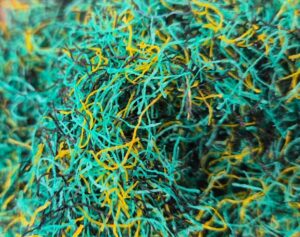
An example of seabed habitat now protected from trawling in 10 seabed management areas. Photo: ACEP Sound Seas
After more than two years of engagement with a team of seabed habitat experts, South African trawler owners and operators have co-developed 10 seabed management areas (SMAs) that the industry voluntarily will comply with.
The agreement follows an extensive collaborative process involving marine scientists and fisheries managers from SADSTIA, the South East Coast Inshore Fishing Association (SECIFA), the fisheries observer agency CapMarine, the South African National Biodiversity Institute, the South African Environmental Observation Network and the Department of Forestry, Fisheries and the Environment. Technical work was partially supported by the Mission Atlantic Project and a PhD was also produced that advanced the identification, mapping and management of vulnerable marine ecosystems (VMEs). Efforts were focused on protecting VMEs within parts of historically trawled areas.
VMEs are fragile, slow-growing communities of marine life such as cold-water corals, sponges and sea pens that provide habitat for other marine life and can take decades or centuries to recover if damaged.
The 10 SMAs are detailed in the map below. They were identified through habitat mapping, scientific analysis and expert review. Portions of most SMAs are located within the trawl ring fence, but SADSTIA and SECIFA members have voluntarily committed not to fish in these areas. Together with formal marine protected areas (MPAs), the SMAs constitute a network of protected seabed areas that balance environmental protection with the continued operation of a well-managed and regulated fishery.

The map shows the 10 SMAs that are being avoided by SADSTIA and SECIFA members. Commercial trawl grid numbers are provided for orientation and the trawl footprint is indicated in blue
What is the impact on trawl operators?
The 10 SMAs represent 1.3% of the total trawl footprint, requiring redistribution of only 0.02% of fishing effort. This minimal impact on operations demonstrates that effective conservation can be achieved without significantly disrupting fishing activities.
Members of SADSTIA and SECIFA initially adopted seven SMAs through a Memorandum of Understanding (MoU) which took effect on 1 January 2025. The remaining three SMAs have been added to the MoU and the permit conditions of the deep-sea and inshore trawl fisheries are being updated to accommodate the ten SMAs. They are expected to improve management of 18 out of 21 VME types (86%) and enhance protection for 12 out of 18 priority marine ecosystem types (67%) relevant to the trawl fishery.
According to Johann Augustyn, SADSTIA Executive Secretary, the adoption of the MoU reflects SADSTIA and SECIFA members’ commitment to evidence-based decision-making and responsible fishing practices. He said the process involved iterative discussions, data review and expert input, allowing both scientists and industry participants to engage constructively on the location, sensitivity and practical implications of protecting specific seabed areas.
“This has been a genuine collaborative effort,” he said. “The agreement demonstrates what can be achieved when environmental scientists and fishing operators work together in good faith, using the best available science to guide decisions.”
By voluntarily protecting sensitive seabed habitats , SADSTIA and SECIFA members are contributing to long-term ecosystem resilience and demonstrating that collaborative, science-led approaches can deliver meaningful environmental gains.
About the 10 SMAs
a. Senqu Anemones – protects areas with high densities of sea anemones and links existing MPAs
b. Hondeklip Sea pens – protects known aggregations of sea pens in an area with low trawl effort and many records of multiple VME indicator taxa
c. Doringbaai VMEs – covers areas with multiple VME species including corals and sea pens
d. Agulhas Lace – links and extends two existing MPAs (Agulhas Muds and Agulhas Bank complex), forming a larger corridor of ocean protection. A rare lace coral occurs in this area
e. Outeniqua Corals – protects confirmed cold-water coral mounds on a steep slope
f. Noetzie Corals – protects a verified cold-water coral reef and poorly protected ecosystem types
g. Coral Koppies East – provides first-time protection for the Kingklip Koppies ecosystem type and stony and bamboo corals
h. Coral Koppies West – provides first-time protection for the Kingklip Koppies ecosystem type and corals, sponges and bryozoans
i. Seaview Horse Mussels – safeguards areas with high densities of horse mussels
j. Addo Canyons – protects submarine canyons with confirmed deep-sea coral habitat and high densities of sea anemones

The Coral Koppies areas will help protect the Kingklip Koppies ecosystem type in an area with many VME habitats and indicator taxa. Photos: ©ACEP Deep Secrets Project/K. Sink.

The Seaview horse mussels area will help maintain complex seabed habitat. ©ACEP Deep Forests Project/K. Sink.