Fish from the sea plays a vital role in feeding a growing global population, but debates about the environmental impact of fishing are often framed in overly simplistic terms. Recent research published in Reviews in Fisheries Science & Aquaculture highlights the importance of looking at the full picture when considering how different food production systems affect biodiversity.
The study, led by Duncan Leadbitter, explores what could happen if wild-caught fish were replaced with animal protein from land-based sources. It suggests that the environmental trade-offs are complex and that reducing or eliminating fishing without considering replacement protein sources could shift environmental pressure from the ocean to the land, with significant implications for global biodiversity.
Leadbitter and colleagues calculated that replacing all wild-caught fish protein with land-based animal protein would require nearly 5 million km2 of additional agricultural land – an area roughly the size of southern Africa, including South Africa, Botswana, Namibia, Zimbabwe and neighbouring countries.
This calculation is based on how people actually behave when they reduce meat consumption: they typically replace it with other animal proteins, not plants. The study assumes the current global mix of livestock production: 40% chicken, 35% pork and 25% beef and lamb. Even more modest changes would require substantial land conversion. Eliminating fish from farmed fish diets (replacing fishmeal with soy) would demand over 47 000 km2 of new agricultural land.
Two very different production systems
Leadbitter’s study highlights a fundamental difference between how fishing and farming affect ecosystems. Farming fundamentally transforms entire landscapes. When land is cleared for crops or livestock, everything changes – from the soil organisms and plants at the base of the food web to the top predators. A farm bears no resemblance to the forest or grassland it replaced. Agriculture also requires fertilisers, pesticides and water, which can pollute rivers and coastal areas.
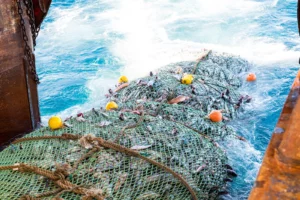
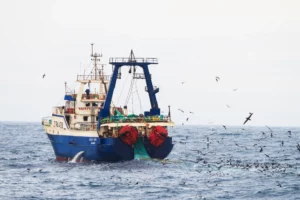
Fishing, by contrast, mainly targets species higher up the food chain. The foundation of marine ecosystems – the phytoplankton and zooplankton that form the base of ocean food webs – remains largely intact. Even bottom trawling – often cited as fishing’s most destructive practice – is less impactful than is often assumed. Research indicates that most trawled areas remain at least 80% intact and impacts vary widely by location – from a few percent of continental shelf affected in places like Australia and Alaska to 80% in the Adriatic Sea.[1]
The extinction risk calculation
Using global conservation data, Leadbitter and colleagues found that agriculture threatens far more species than fishing and that extinction risk per unit of animal protein is around 2.6 times higher for agriculture than for wild-caught fish.
Because most agricultural expansion historically occurs at the expense of natural habitats – particularly tropical forests – shifting protein production from ocean to land could increase overall biodiversity loss.
The study’s authors do not argue against all fishing restrictions. They acknowledge that sustainable fishing limits are essential and that well-managed fisheries have successfully rebuilt stocks and protected ecosystems. Their concern is with calls to restrict fishing beyond what sustainability requires – complete bans, eliminating entire gear types or closing vast ocean areas without considering where replacement protein will come from.
They suggest that improved fisheries management could actually increase sustainable catches by an estimated 16 million tons annually. By their calculations, this could effectively protect over 1 million km2 of rainforest that would otherwise be cleared for agriculture.
The picture is likely to become more complicated. Plant-based seafood alternatives are entering the market with sustainability claims that may or may not account for their full environmental footprint. Lab-grown seafood remains in development, with uncertain environmental benefits.
The study conducted by Leadbitter and colleagues does not provide simple answers, but it does suggest that calls to dramatically reduce fishing deserve the same scrutiny that is applied to agricultural expansion. The question is not whether to protect ocean ecosystems – it is how to feed humanity while minimising total biodiversity loss across both land and sea.
The full study is available here:
Leadbitter, D., Aebischer, N.J., Auchterlonie, N.A., Benton, T.G., Froehlich, H.E., Hall, S., Kaiser, M.J., Palme, U. & Hilborn, R. 2025. Biodiversity consequences of replacing animal protein from capture fisheries with animal protein from agriculture. Reviews in Fisheries Science & Aquaculture. https://doi.org/10.1080/23308249.2025.2585414
[1] Amoroso, R.O., Pitcher, C.R., Rijnsdorp, A.D. & Jennings, S. 2018. Bottom trawl fishing footprints on the world’s continental shelves. Sustainability Science. https://doi.org/10.1073/pnas.1802379115