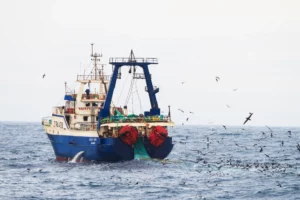
Inshore trawlers berthed in Mossel Bay
When Colin Attwood from the University of Cape Town’s Department of Biological Sciences began studying South Africa’s inshore fishery in 2014, he and his team of researchers uncovered a complex web of challenges that would reshape how the industry thinks about managing bycatch. This decade-long research effort, which is ongoing, is both a scientific study and a real-world attempt to balance conservation needs with economic realities in South Africa’s fishing industry.
The research revealed that approximately 20 fish species make up about 99% of catches, but another 100 species appear infrequently in the nets of inshore trawlers. This create a significant management challenge: how do you regulate an industry that catches several species simultaneously, when traditional fisheries management focuses on just one or two?
The quota trap
Traditional fisheries management relies heavily on quotas – limits on how much of each species can be caught. But in a multi-species fishery which has hard quotas for every species, this creates what researchers call a “quota trap.” This sees fishers who reach the quote for one species faced with a difficult choice: stop fishing entirely, or continue fishing and discard the over-quota species? The consequences of the quota trap can be severe. Fishers may delay landing their quota species while selling unregulated bycatch, or worse, they may discard protected species to avoid being penalised.
South Africa partially avoids the quota trap by using “precautionary upper catch limits” commonly known as “PUCLs”. These function as softer, more flexible limits that trigger early warnings when catches of a particular species approach maximum levels, rather than creating hard stops. But control on fish mortality with PUCLs may not be effective.
Attwood’s research has highlighted alternative management models that have been successfully applied in other fisheries facing similar challenges to the inshore trawl fishery. One of these is a quota trading system.
In trading quotas, companies can exchange their species allocations with each other. When one operator lands heavy catches of species A but minimal amounts of species B, they can trade surplus A allocation for additional B quota with another company facing the inverse situation, enabling both to continue operations within regulatory bounds. This approach eliminates discard incentives entirely, because operators can rebalance their catch portfolios through allocation trading rather than dumping commercially valuable but quota-constrained species overboard.
However, implementing this solution might face significant hurdles, particularly around competition law. The proposed trading system requires fishing companies to share information and coordinate their activities – behaviour that could be seen as anti-competitive collusion in other industries.
The fishing industry remains nervous about any system that might attract attention from competition authorities. This creates a fundamental tension between conservation goals that require industry-wide coordination and competition laws designed to prevent market manipulation.
Additional challenges include the reluctance of competing companies to share sensitive business information, the cost of improved catch reporting and sorting systems and the difficulty of getting companies of vastly different sizes and resources to participate equally in the system.
Mixed results after a decade
Ten years after the project began, the results are mixed but encouraging in some areas, Attwood explains. Most importantly, catches of most species have remained well below the PUCLs, meaning the emergency measures built into the system have not been triggered. This suggests that many fish stocks in the inshore fishery are more resilient than initially thought. Some species that were of particular concern in 2014, such as white stumpnose, have shown signs of improvement in recent assessments.
The Marine Stewardship Council (MSC) certification process has also played a valuable role in encouraging transparency and cooperation within the industry. “MSC certification has encouraged the industry to be more open about these things and to be more cooperative and to consider better ways of doing things,” Attwood observes.
Despite progress, significant challenges remain. Government capacity for conducting regular stock assessments is limited, meaning some species receive little scientific attention. The power imbalance between large and small fishing companies makes industry-wide coordination difficult, and the practical challenge of placing observers on all vessels remains unresolved. Inshore trawlers are small and carrying an observer may displace a crew member and impact operations.
The industry also operates under multiple regulatory frameworks beyond fisheries management, including maritime safety, labour law, health standards and competition law. This regulatory complexity means that fishing companies must balance conservation goals against numerous other business pressures.
Attwood believes that the future of bycatch management may lie in technology and better prediction systems. An artificial intelligence system to automatically count and identify bycatch species caught in the nets of deep-sea trawlers has already been developed for the offshore fishery and Attwood is hopeful it can be modified for use in the inshore fishery. Statistical models are also being adapted to predict end-of-year catches based on mid-year data, potentially allowing for proactive management decisions.
“If we know what the likely projection is for the end of the year, one can take some timely action,” Attwood explains. This could include redirecting fishing effort to different areas or deploying additional observers to monitor specific species.
Lessons for global fisheries
The South African experience offers valuable lessons for other fisheries facing similar challenges. Success requires understanding the economic realities facing fishing companies, recognizing that conservation and business problems are often the same problem, and designing management systems that work with, rather than against, economic incentives.
Perhaps most importantly, the research demonstrates that effective fisheries management requires moving beyond simple regulatory approaches toward collaborative systems that acknowledge the complexity of both marine ecosystems and the businesses that depend on them.
The inshore fishery’s experience shows that while managing bycatch in multi-species fisheries is a challenging problem for fisheries science, innovative approaches that combine economic incentives with scientific monitoring can make meaningful progress toward more sustainable fishing practices.

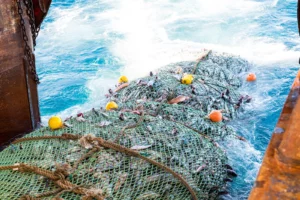
Cape horse mackerel is a commonly caught bycatch species of the inshore trawl fishery